Example 1: MMS on the Unit Square
Problem Setup
We verify the DG advection-diffusion implementation using the Method of Manufactured Solutions (MMS) on a unit square domain with a prescribed uniform upward velocity field .
The governing equation is:
Boundary Conditions
All four sides carry a Dirichlet condition for the diffusion term (), imposed weakly via SIPG. The advection inflow/outflow split is determined by :
| Boundary | Location | Advection type | |
|---|---|---|---|
| Bottom | Inflow — prescribed | ||
| Top | Outflow — interior trace used | ||
| Left / Right | 0 | Wall — no advective flux |
Source
import numpy as np
import matplotlib
import matplotlib.pyplot as plt
import matplotlib.patches as patches

matplotlib.rcParams['svg.fonttype'] = 'none'

fig, ax = plt.subplots(figsize=(3.5, 3.5))
ax.add_patch(patches.Rectangle((0, 0), 1, 1, facecolor='white', edgecolor='black', linewidth=1.5, zorder=1))
ax.text(0.5, 0.5, r'$\Omega$', ha='center', va='center', fontsize=18)
ax.text(0.5, -0.06, r'$\Gamma_D$ (inflow)',  ha='center', va='top',    fontsize=10)
ax.text(0.5,  1.06, r'$\Gamma_D$ (outflow)', ha='center', va='bottom', fontsize=10)
ax.text(-0.06, 0.5, r'$\Gamma_D$ (wall)',    ha='right',  va='center', fontsize=10)
ax.text( 1.06, 0.5, r'$\Gamma_D$ (wall)',    ha='left',   va='center', fontsize=10)
for xi in [0.3, 0.7]:
    for yi in [0.2, 0.5, 0.78]:
        ax.annotate('', xy=(xi, yi + 0.11), xytext=(xi, yi),
                    arrowprops=dict(arrowstyle='->', color='black', lw=1.2), zorder=2)
ax.text(0.82, 0.88, r'$\mathbf{w}$', fontsize=13, ha='center')
ax.set_xlim(-0.35, 1.35); ax.set_ylim(-0.18, 1.18)
ax.set_aspect('equal'); ax.axis('off')
plt.tight_layout()
fig.savefig('domain_mwe1.svg', bbox_inches='tight')
plt.close(fig)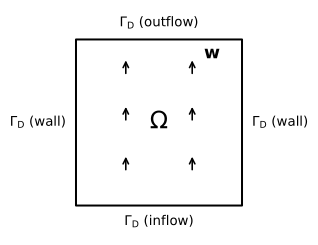
Manufactured Solution
The exact solution is chosen to contain both a smooth oscillatory component and an exponential boundary layer near the outflow boundary ():
The first term produces a layer of thickness near ; for small (large Péclet number) this layer becomes sharp. The source term is derived analytically from so that it satisfies the PDE exactly.
Source
import numpy as np
import matplotlib
import matplotlib.pyplot as plt
import ufl

matplotlib.rcParams['svg.fonttype'] = 'none'

D = 0.1

def exact_solution(x, D):
    """UFL exact solution, used inside the weak form."""
    return (
        ufl.cos(ufl.pi * x[0]) * (1 - ufl.exp((x[1] - 1) / D)) / (1 - ufl.exp(-2 / D))
        + 0.5 * ufl.cos(ufl.pi * x[0]) * ufl.sin(ufl.pi * x[1])
    )

def u_exact_np(x, y, D):
    """NumPy exact solution, used for plotting."""
    return (
        np.cos(np.pi * x) * (1 - np.exp((y - 1) / D)) / (1 - np.exp(-2 / D))
        + 0.5 * np.cos(np.pi * x) * np.sin(np.pi * y)
    )

x = np.linspace(0, 1, 300)
y = np.linspace(0, 1, 300)
X, Y = np.meshgrid(x, y)
U = u_exact_np(X, Y, D)

fig, ax = plt.subplots(figsize=(4.5, 4))
cf = ax.pcolormesh(X, Y, U, cmap='RdBu_r', shading='auto',
                   edgecolors='face', rasterized=True)
cbar = plt.colorbar(cf, ax=ax, shrink=0.9)
cbar.set_label(r'$u_\mathrm{exact}$', fontsize=10)
ax.set_aspect('equal')
ax.set_xlabel(r'$x$', fontsize=11)
ax.set_ylabel(r'$y$', fontsize=11)
ax.set_title(r'Manufactured solution ($D = 0.1$)', fontsize=11)
ax.spines['top'].set_visible(False)
ax.spines['right'].set_visible(False)
plt.tight_layout()
fig.savefig('solution_mwe1.svg', bbox_inches='tight', dpi=200)
plt.close(fig)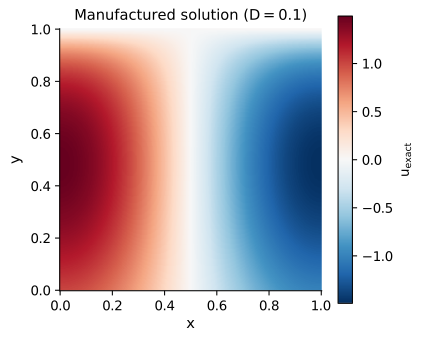
Problem formulation
We build the unit square mesh, define the DG function space and test function, and set the physical parameters: , . The relevant measure of the balance between advection and diffusion is the mesh Péclet number , where is the local mesh size. For a mesh on the unit square, , giving , so this is a diffusion-dominated case. The penalty parameter is set to .
from mpi4py import MPI
from petsc4py import PETSc
import numpy as np
import matplotlib as mpl
import matplotlib.pyplot as plt
from dolfinx import fem, mesh, geometry
from dolfinx.fem.petsc import NonlinearProblem

N = 64
degree = 1
D_value = 0.1
w_mag   = 1.0

msh = mesh.create_unit_square(
    MPI.COMM_WORLD, N, N,
    cell_type=mesh.CellType.triangle,
    diagonal=mesh.DiagonalType.crossed,
)

V = fem.functionspace(msh, ("DG", degree))
u = fem.Function(V)
v = ufl.TestFunction(V)

x = ufl.SpatialCoordinate(msh)
n = ufl.FacetNormal(msh)
h = ufl.CellDiameter(msh)

D       = fem.Constant(msh, PETSc.ScalarType(D_value))
w       = fem.Constant(msh, PETSc.ScalarType((0, w_mag)))
penalty = fem.Constant(msh, PETSc.ScalarType(10.0 * degree**2))

u_ex = exact_solution(x, D)
f    = -ufl.div(D * ufl.grad(u_ex)) + ufl.dot(w, ufl.grad(u_ex))

dx, ds, dS = ufl.dx, ufl.ds, ufl.dS
The indicator function determines whether a given face is an outflow or inflow/wall face with respect to the advective velocity:
This allows the upwind advective flux to be written compactly. On an interior face with normal , the combination reduces to the standard upwind flux , where is the value from the upwind element.
On the boundary , is used to split the advective boundary contribution: the outflow term enters the bilinear form using the interior trace, while the inflow term prescribes the inflow data on the right-hand side.
lmbda = ufl.conditional(ufl.gt(ufl.dot(w, n), 0), 1, 0)Advection
The advection contribution groups the bulk volume term, the interior upwind flux, and both boundary cases together:
F = 0

# Advection, bulk
F += -ufl.inner(w * u, ufl.grad(v)) * dx

# Advection, interior upwind flux
F += ufl.inner(2 * ufl.avg(lmbda * w * u), ufl.jump(v, n)) * dS

# Advection, outflow BC (interior trace)
F += ufl.inner(lmbda * ufl.dot(w, n) * u, v) * ds

# Advection, inflow BC (prescribed data)
F += -ufl.inner((1 - lmbda) * ufl.dot(w, n) * u_ex, v) * ds
Diffusion (SIPG)
The symmetric interior penalty formulation consists of the bulk gradient term, two face terms to restore consistency and symmetry, and an inter-element penalty:
# Diffusion, bulk
F += D * ufl.inner(ufl.grad(u), ufl.grad(v)) * dx

# Diffusion, SIPG interior faces
F += -D * ufl.inner(ufl.avg(ufl.grad(u)), ufl.jump(v, n)) * dS
F += -D * ufl.inner(ufl.jump(u, n), ufl.avg(ufl.grad(v))) * dS
F += D * (penalty / ufl.avg(h)) * ufl.inner(ufl.jump(u, n), ufl.jump(v, n)) * dS
Weak Dirichlet Condition and Source
The Dirichlet condition on is imposed weakly by mirroring the SIPG treatment at boundary faces. The manufactured source closes the residual:
# Weak Dirichlet (SIPG on boundary)
F += D * (
    -ufl.inner(ufl.grad(u), v * n) * ds
    - ufl.inner(ufl.grad(v), (u - u_ex) * n) * ds
    + (penalty / h) * ufl.inner(u - u_ex, v) * ds
)

# Source
F += -ufl.inner(f, v) * dx
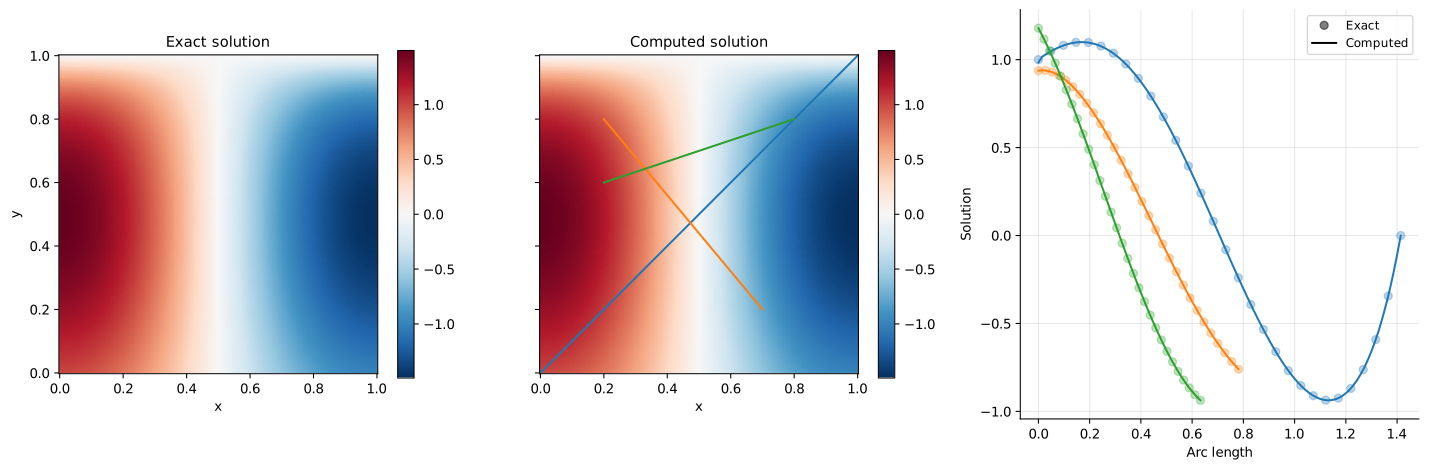
We can then solve the problem and compare against the exct solution with the L2 error
problem = NonlinearProblem(
    F, u, J=ufl.derivative(F, u),
    petsc_options_prefix="advecdiff",
    petsc_options={
        "snes_type": "newtonls",
        "snes_linesearch_type": "none",
        "snes_rtol": 1e-10,
        "snes_atol": 1e-10,
        "snes_max_it": 20,
        "ksp_type": "preonly",
        "pc_type": "lu",
    },
)
u = problem.solve()
u.x.scatter_forward()

error_form = fem.form((u - u_ex) ** 2 * dx)
l2_error = np.sqrt(msh.comm.allreduce(fem.assemble_scalar(error_form), op=MPI.SUM))

print(f"L2 error: {l2_error:.3e}")
L2 error: 1.547e-03
Source
def eval_at_points(uh, pts_2d):
    """Evaluate a DOLFINx Function at an (N, 2) array of (x, y) points."""
    msh = uh.function_space.mesh
    pts_3d = np.column_stack([pts_2d, np.zeros(len(pts_2d))])
    bb = geometry.bb_tree(msh, msh.topology.dim)
    candidates = geometry.compute_collisions_points(bb, pts_3d)
    colliding  = geometry.compute_colliding_cells(msh, candidates, pts_3d)
    cells = np.array(
        [colliding.links(i)[0] if len(colliding.links(i)) > 0 else -1
         for i in range(len(pts_2d))], dtype=np.int32
    )
    vals = np.full(len(pts_2d), np.nan)
    valid = cells >= 0
    if valid.any():
        vals[valid] = uh.eval(pts_3d[valid], cells[valid]).flatten()
    return vals


def compute_arc_length(xs, ys):
    points = np.vstack((xs, ys)).T
    dist   = np.linalg.norm(points[1:] - points[:-1], axis=1)
    return np.insert(np.cumsum(dist), 0, 0.0)


# Colourmap grid
Np = 200
xv, yv = np.linspace(0, 1, Np), np.linspace(0, 1, Np)
Xg, Yg = np.meshgrid(xv, yv)
U_ex_grid = u_exact_np(Xg, Yg, D_value)
U_h_grid  = eval_at_points(u, np.column_stack([Xg.ravel(), Yg.ravel()])).reshape(Np, Np)
vmin, vmax = U_ex_grid.min(), U_ex_grid.max()

# Sample profiles
profiles = [
    {"start": (0.0, 0.0), "end": (1.0, 1.0)},
    {"start": (0.2, 0.8), "end": (0.7, 0.2)},
    {"start": (0.2, 0.6), "end": (0.8, 0.8)},
]

fig, axs = plt.subplots(1, 3, figsize=(15, 5))

for ax, data, title in zip(axs[:2],
                            [U_ex_grid, U_h_grid],
                            ["Exact solution", "Computed solution"]):
    CS = ax.pcolormesh(Xg, Yg, data, cmap="RdBu_r", shading="auto",
                       vmin=vmin, vmax=vmax, rasterized=True)
    CS.set_edgecolor("face")
    plt.colorbar(CS, ax=ax, shrink=0.8)
    ax.set_title(title, fontsize=11)
    ax.set_xlabel("$x$", fontsize=10)
    ax.set_aspect("equal")

axs[0].set_ylabel("$y$", fontsize=10)
axs[0].sharey(axs[1])
plt.setp(axs[1].get_yticklabels(), visible=False)

# Profiles
for profile in profiles:
    sx, sy = profile["start"]
    ex, ey = profile["end"]

    (line,) = axs[1].plot([sx, ex], [sy, ey])
    c = line.get_color()

    # Exact: fewer points, markers
    xs_ex = np.linspace(sx, ex, 30)
    ys_ex = np.linspace(sy, ey, 30)
    arc_ex = compute_arc_length(xs_ex, ys_ex)
    u_ex_vals = u_exact_np(xs_ex, ys_ex, D_value)

    # Computed: more points, solid line
    xs_h = np.linspace(sx, ex, 100)
    ys_h = np.linspace(sy, ey, 100)
    arc_h = compute_arc_length(xs_h, ys_h)
    u_h_vals = eval_at_points(u, np.column_stack([xs_h, ys_h]))

    axs[2].plot(arc_ex, u_ex_vals, marker="o", linestyle="None",
                color=c, alpha=0.3)
    axs[2].plot(arc_h,  u_h_vals,  color=c)

axs[2].set_xlabel("Arc length", fontsize=10)
axs[2].set_ylabel("Solution",   fontsize=10)
axs[2].grid(alpha=0.3)
axs[2].spines[["right", "top"]].set_visible(False)

legend_marker = mpl.lines.Line2D([], [], color="black", marker="o",
                                  linestyle="None", alpha=0.5, label="Exact")
legend_line   = mpl.lines.Line2D([], [], color="black", label="Computed")
axs[2].legend(handles=[legend_marker, legend_line], fontsize=9)

plt.tight_layout()
fig.savefig('mwe1_comparison.svg', bbox_inches='tight', dpi=200)
plt.close(fig)
Convergence Test
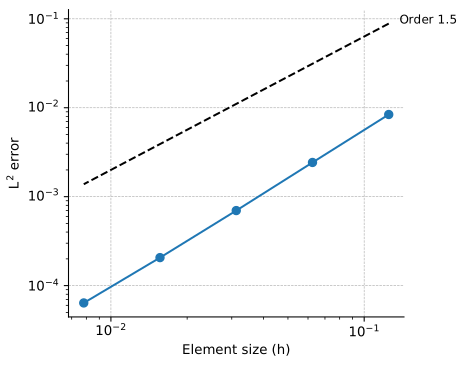
The mesh is refined uniformly () and the error is tracked. For a degree- DG space with upwind advection flux, the expected convergence rate on general unstructured meshes is . This is one half-order below the optimal elliptic rate obtained by SIPG for pure diffusion, and reflects the hyperbolic character of the upwind flux. For the expected rate is therefore , which is used as the reference slope in the plot below.
Source
def solve_advection_diffusion(N, degree=1, D_value=0.1, w_mag=1.0):
    msh = mesh.create_unit_square(
        MPI.COMM_WORLD, N, N,
        cell_type=mesh.CellType.triangle,
        diagonal=mesh.DiagonalType.crossed,
    )

    V = fem.functionspace(msh, ("DG", degree))
    u = fem.Function(V)
    v = ufl.TestFunction(V)

    x = ufl.SpatialCoordinate(msh)
    n = ufl.FacetNormal(msh)
    h = ufl.CellDiameter(msh)

    D  = fem.Constant(msh, PETSc.ScalarType(D_value))
    w  = fem.Constant(msh, PETSc.ScalarType((0, w_mag)))

    u_ex    = exact_solution(x, D)
    f       = -ufl.div(D * ufl.grad(u_ex)) + ufl.dot(w, ufl.grad(u_ex))
    penalty = fem.Constant(msh, PETSc.ScalarType(10.0 * degree**2))
    lmbda   = ufl.conditional(ufl.gt(ufl.dot(w, n), 0), 1, 0)

    dx, ds, dS = ufl.dx, ufl.ds, ufl.dS

    F = 0

    # Advection, upwind flux
    F += -ufl.inner(w * u, ufl.grad(v)) * dx
    F += ufl.inner(2 * ufl.avg(lmbda * w * u), ufl.jump(v, n)) * dS
    F += ufl.inner(lmbda * ufl.dot(w, n) * u, v) * ds

    # Diffusion, SIPG
    F += D * ufl.inner(ufl.grad(u), ufl.grad(v)) * dx
    F += -D * ufl.inner(ufl.avg(ufl.grad(u)), ufl.jump(v, n)) * dS
    F += -D * ufl.inner(ufl.jump(u, n), ufl.avg(ufl.grad(v))) * dS
    F += D * (penalty / ufl.avg(h)) * ufl.inner(ufl.jump(u, n), ufl.jump(v, n)) * dS

    # Weak Dirichlet (SIPG on boundary)
    F += D * (
        -ufl.inner(ufl.grad(u), v * n) * ds
        - ufl.inner(ufl.grad(v), (u - u_ex) * n) * ds
        + (penalty / h) * ufl.inner(u - u_ex, v) * ds
    )

    # Inflow BC
    F += -ufl.inner((1 - lmbda) * ufl.dot(w, n) * u_ex, v) * ds

    # Source
    F += -ufl.inner(f, v) * dx

    problem = NonlinearProblem(
        F, u, J=ufl.derivative(F, u),
        petsc_options_prefix="advecdiff",
        petsc_options={
            "snes_type": "newtonls",
            "snes_linesearch_type": "none",
            "snes_rtol": 1e-10,
            "snes_atol": 1e-10,
            "snes_max_it": 20,
            "ksp_type": "preonly",
            "pc_type": "lu",
        },
    )
    u = problem.solve()
    u.x.scatter_forward()

    error_form = fem.form((u - u_ex) ** 2 * dx)
    l2_error = np.sqrt(msh.comm.allreduce(fem.assemble_scalar(error_form), op=MPI.SUM))

    return l2_error, u


errors = []
Ns = [8, 16, 32, 64, 128]

for N in Ns:
    err, _ = solve_advection_diffusion(degree=1, w_mag=0.1, N=N, D_value=0.1)
    errors.append(err)
    print(f"N = {N:3d},  L2 error = {err:.6e}")

h = np.array([1 / N for N in Ns], dtype=float)
errors = np.array(errors)

fig, ax = plt.subplots(figsize=(5, 4))
ax.loglog(h, errors, "o-")
ax.loglog(h, 2 * h**1.5, "--k")
ax.annotate("Order 1.5", (h[0], 2 * h[0]**1.5),
            textcoords="offset points", xytext=(8, 0), fontsize=9)
ax.set_ylabel("$L^2$ error", fontsize=10)
ax.set_xlabel("Element size ($h$)", fontsize=10)
ax.grid(True, which="major", ls="--", lw=0.5)
ax.spines["top"].set_visible(False)
ax.spines["right"].set_visible(False)
plt.tight_layout()
fig.savefig('mwe1_conv_mesh.svg', bbox_inches='tight', dpi=200)
plt.close(fig)
N =   8,  L2 error = 8.397482e-03
N =  16,  L2 error = 2.425757e-03
N =  32,  L2 error = 6.980604e-04
N =  64,  L2 error = 2.065179e-04
N = 128,  L2 error = 6.386110e-05
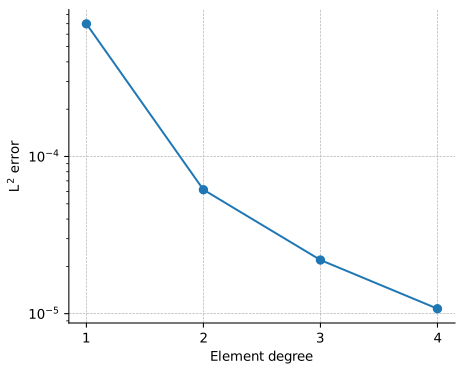
The second test fixes the mesh at and sweeps the polynomial degree , with and . At this mesh size the cell Péclet number is , placing the problem firmly in the diffusion-dominated regime. In this regime the SIPG method recovers the optimal elliptic rate per degree, so for a fixed mesh the error should decrease monotonically and rapidly with increasing . The manufactured solution is analytic on , which favours fast algebraic (and in principle exponential) convergence in .
Source
errors = []
degrees = [1, 2, 3, 4]
N = 32

for deg in degrees:
    err, _ = solve_advection_diffusion(degree=deg, w_mag=0.1, N=N, D_value=0.1)
    errors.append(err)
    print(f"Deg = {deg:3d},  L2 error = {err:.6e}")

errors = np.array(errors)

fig, ax = plt.subplots(figsize=(5, 4))
ax.plot(degrees, errors, "o-")
ax.set_yscale("log")
ax.set_ylabel("$L^2$ error", fontsize=10)
ax.set_xlabel("Element degree", fontsize=10)
ax.set_xticks(degrees)
ax.grid(True, which="major", ls="--", lw=0.5)
ax.spines["top"].set_visible(False)
ax.spines["right"].set_visible(False)
plt.tight_layout()
fig.savefig('mwe1_conv_deg.svg', bbox_inches='tight', dpi=200)
plt.close(fig)
Deg =   1,  L2 error = 6.980604e-04
Deg =   2,  L2 error = 6.145345e-05
Deg =   3,  L2 error = 2.194764e-05
Deg =   4,  L2 error = 1.075512e-05